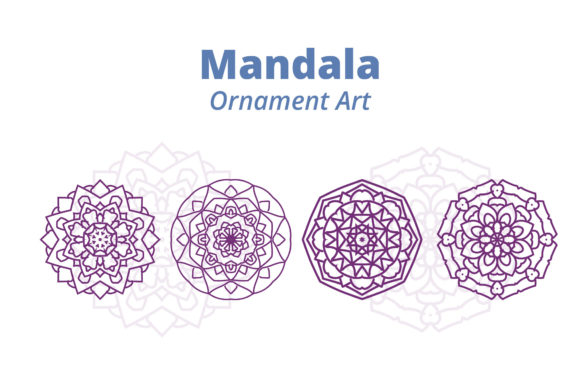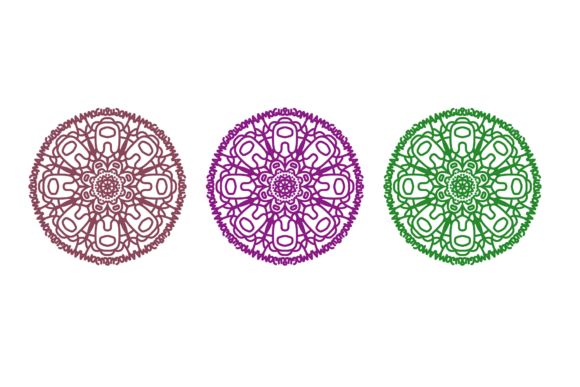
Mandala Decorative Bundle: A Designer’s Real-Use Review
First Impressions: Calm, Centered, and Craft-Ready
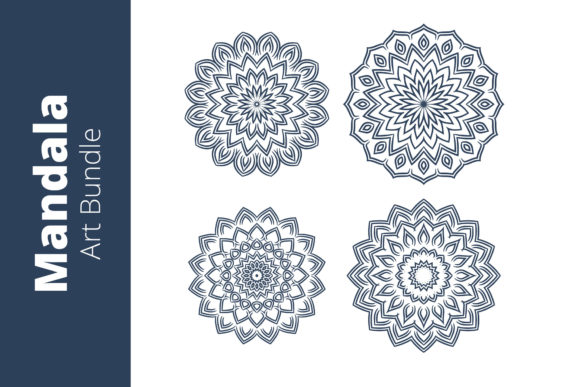
Opening the Mandala Decorative Bundle feels like unrolling a quiet invitation — not flashy, but deeply intentional. The six digital files (AI and EPS) sit on a generous 1920px × 1280px canvas, giving breathing room for scaling without pixelation. As a designer who’s stitched hundreds of mandalas — from delicate baby onesies to bold tote bag centerpieces — I immediately notice what this bundle *doesn’t* do: it doesn’t overcomplicate. No frantic linework, no competing layers, no forced symmetry that reads stiff. Instead, it offers balanced repetition, gentle rhythm, and clear visual hierarchy. It’s the kind of pattern that works as both focal point and subtle grounding element — ideal for embroidery projects where presence matters more than punctuation.
A Real Project Test: Embroidering a Linen Kitchen Towel
Last week, I used one design from the Mandala Decorative Bundle to embroider a heavyweight linen tea towel for a local boutique’s holiday collection. Why this piece? Because mandalas translate beautifully to kitchen textiles — they’re soothing, timeless, and hold up well in functional settings. I chose the cleanest layout (no fine inner filigree), resized it to fit a 5″ hoop comfortably, and ran a test stitch on scrap linen with tear-away stabilizer. The result? Crisp satin stitch rings, even fill-stitch zones without puckering, and zero thread breaks — even at moderate speed. Customers responded strongly: “It feels handmade, not mass-produced,” one said. That’s the Mandala Decorative Bundle’s quiet strength — it supports authenticity, not just aesthetics.
Where It Shines — And Where to Pause
The Mandala Decorative Bundle excels on stable, medium-weight fabrics: cotton twill aprons, organic cotton sweatshirts, denim tote bags, and structured pillow covers. On baby onesies or knit caps? Use the simplest variant — avoid designs with dense inner geometry unless you’re using lightweight cut-away stabilizer and reducing stitch density manually. For dark fabric, test contrast first: some mandala motifs rely on subtle tonal shifts that vanish on black or navy unless you adjust thread colors thoughtfully. On curved surfaces like baseball caps, stick to smaller-scale versions — the full 1920px canvas won’t hoist cleanly without distortion.
Here’s what to watch for:
- Hoop size alignment: The canvas is large, but your machine’s max hoop may be smaller — always scale down *before* digitizing, not after.
- Fabric texture: Highly napped fabrics (like fleece or terry cloth) can obscure fine line work — simplify or omit outer rings if needed.
- Wash durability: Dense fill areas hold up well, but tightly packed running-stitch borders may loosen over time on high-use items like dish towels — reinforce with a light backing stitch if selling commercially.
- Commercial use clarity: Since the listing doesn’t specify license terms, verify whether resale of finished embroidered goods — or bundling these files into your own digital product — is permitted.
Design Integrity Meets Customer Trust
When I sell embroidered goods, every stitch communicates care — and Mandala Decorative Bundle supports that message. Its clean vector foundation (AI/EPS) means no jagged edges when scaled, no blurry previews in Etsy listings, and smooth transitions in printable mockups. That consistency builds buyer confidence: a customer seeing a sharp digital preview expects — and receives — the same precision in the finished product. It also helps maintain brand cohesion across product lines. Whether you’re stitching matching nursery decor (a crib sheet + wall hanging) or curating a boutique gift set (tote + tea towel + embroidered coaster), this bundle provides unified visual language — not just decoration.
Practical Notes Every Embroidery Designer Should Check
Before cutting fabric or loading your machine:
- Test the design on scrap fabric *with your exact stabilizer and thread combo* — especially if working with textured or stretchy materials.
- Review stitch density visually — zoom in on vector files to spot potential crowding in inner rings or overlapping elements.
- Confirm your hoop size fits the intended dimensions; don’t assume “medium” means the same across brands.
- Inspect small details at 200% zoom: tiny dots, thin connecting lines, or narrow gaps may vanish in stitch-out if too fine.
- Try a black-and-white mockup: if the design loses legibility or balance without color, simplify before embroidering.
- Compare performance on light vs. dark backgrounds — some mandala layouts rely on negative space that disappears on black fabric.
- Use appropriate stabilizer: cut-away for knits, tear-away for wovens, and fusible for lightweight linens.
- Double-check licensing — especially if you plan to resell the embroidered item or include these files in a craft bundle.
Final Thought: Not Just a Pattern — A Design Partner
The Mandala Decorative Bundle isn’t about trend-chasing. It’s a thoughtful, scalable resource for makers who value intention over ornament. It works quietly in the background of a custom embroidered sweatshirt, lifts the elegance of a handmade baby blanket, and adds quiet sophistication to an Etsy patch listing. As a designer, I reach for it when I need reliability — not reinvention. When your goal is to create something that feels both personal and polished, this bundle delivers. Just remember: its strength lies in how you use it — not just what it is. Test it, scale it wisely, stabilize it properly, and let the mandala do what it does best — center the work, and the maker, alike.