Decorative Yin Yang
A Designer’s First Glance: Clean, Balanced, and Quietly Confident
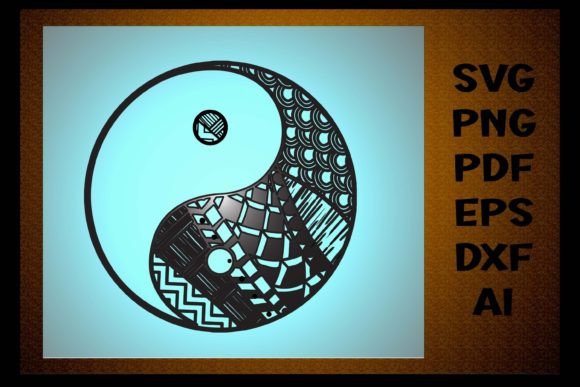
When I opened Decorative Yin Yang for the first time, I didn’t see a cliché—I saw intention. The curves are smooth but not overly soft; the division line has subtle weight, not a razor-thin edge. It breathes. That matters—especially when translating into thread. As a designer who regularly selects embroidery files for client projects and my own small shop line, I immediately pictured it stitched on a heavyweight organic cotton tote bag: no background fill, just the outline and gentle interior contours, rendered in matte black thread on oat-colored fabric. It felt grounded—not flashy, but unmistakably handmade and thoughtful.
Where This Design Earns Its Keep
Decorative Yin Yang isn’t shouting for attention. It works best where quiet symbolism meets everyday utility. I recently used a version of this motif (after vetting the stitch execution) for a limited-run batch of linen aprons for a local herbalist’s boutique. Customers responded to its calm presence—not as “spiritual decor,” but as a visual pause amid busy kitchen or studio work. That’s the sweet spot: personalized gifts, small shop products, and custom apparel where meaning is implied, not explained.
It holds up well across several real-world embroidery contexts:
- Sweatshirt embroidery: On midweight fleece, the balanced proportions prevent distortion—even with slight stretching during hooping.
- Embroidered patch: Clean outer edge and moderate detail level make it ideal for heat-seal or sew-on patches—no tiny filigree to snag or fray.
- Baby embroidery: Rounded forms and absence of sharp angles suit onesies and burp cloths—plus, the symmetry reads clearly even at 2.5" tall.
- Holiday embroidery: Paired with minimalist typography (“Peace,” “Balance,” “Breathe”), it elevates handmade ornaments or tea towel sets without seasonal clichés.
- Digital embroidery file preview: Renders cleanly in printable mockups—no pixelation in satin-stitch zones, and the curve continuity translates smoothly to vector-based previews for Etsy listings.
Where Caution Is Built Into the Stitch
This isn’t a design that forgives rushed prep. Its elegance depends on precision—and that means knowing your limits before pressing start.
On thin fabric like rayon challis or lightweight voile, the inner curve junctions can blur if stabilizer isn’t layered thoughtfully. I recommend a light tear-away + cut-away combo—not just for support, but to keep the negative space between yin and yang crisp.
For curved surfaces like caps or structured tote handles, test the hoop size early. If the design spans more than 3.5" wide, you’ll likely need re-hooping or digitizing adjustments—especially where the central dot meets the outer arc. That junction is delicate in stitch density; too much fill stitch there risks puckering on stretchy knits.
And while Decorative Yin Yang reads beautifully on dark fabric, avoid relying solely on high-contrast thread unless you’ve confirmed the fill stitch coverage. Some versions of this motif use sparse running stitch for interior definition—fine on white, but nearly invisible on navy unless backed with underlay or adjusted in software.
What It Adds to Your Finished Product—Beyond Aesthetics
Customers don’t buy symbols—they buy resonance. When someone chooses a handmade product with Decorative Yin Yang, they’re signaling care: for balance, for intention, for quiet strength. That elevates perceived value—especially for personalized gifts and small business merchandise. In my experience, items featuring this design convert better in boutique settings when styled simply: no extra text, no borders, just the motif centered on a natural-fiber surface.
It also supports brand consistency. Whether you’re an Etsy seller, a craft business launching a wellness-themed line, or a digital product seller bundling embroidery assets, Decorative Yin Yang functions as a versatile anchor—scalable, recognizable at glance, and adaptable across categories (tote bag design, pillow cover, nursery decor) without feeling repetitive.
Practical Embroidery Designer Notes—No Guesswork
Before stitching Decorative Yin Yang into anything client-facing or inventory-bound, here’s what I do every time:
- Test on scrap fabric—same fiber content and weight as the final piece. Watch how the inner curve stitches lay down on seam allowances or curved edges.
- Check thread color contrast in natural light *and* under warm LED. Matte black on charcoal? Might read as flat. Try charcoal thread on black—sometimes subtlety wins.
- Review stitch density in the central dot and along the dividing line. Overly dense satin stitch here can cause stiffness; too sparse, and the shape loses definition.
- Confirm hoop size compatibility with your machine and project type. If you’re embroidering on a child’s cap, verify the design fits within your smallest stable hoop area without compression.
- Inspect small details at 200% zoom in your embroidery software. Does the transition between satin and fill stitch feel intentional—or muddy?
- Test in black-and-white mockups. If it reads clearly without color cues, you’ve got strong silhouette integrity.
- Compare light vs. dark fabric backgrounds using your actual thread palette—not just screen previews.
- Use proper stabilizer for the fabric *and* the end use. A tea towel meant for daily washing needs different backing than a framed wall hanging.
- Verify licensing before selling finished items or bundling Decorative Yin Yang into commercial design assets. Since it’s listed under Crafts and Graphics, confirm whether personal or small-batch commercial use is included—or if separate permissions apply.
Final Thought: It’s Not Just a Shape—It’s a Design Decision
Decorative Yin Yang earns respect not because it’s complex, but because it asks for attention to craft. It rewards careful hooping, smart stabilizing, and thoughtful fabric pairing. Used well, it becomes part of a larger story—whether that’s a slow-living brand’s ethos, a therapist’s office gift set, or a handmade baby blanket passed down with intention. For embroidery designers, apparel decorators, and creative entrepreneurs, it’s less about adding decoration—and more about choosing meaning, one precise stitch at a time.