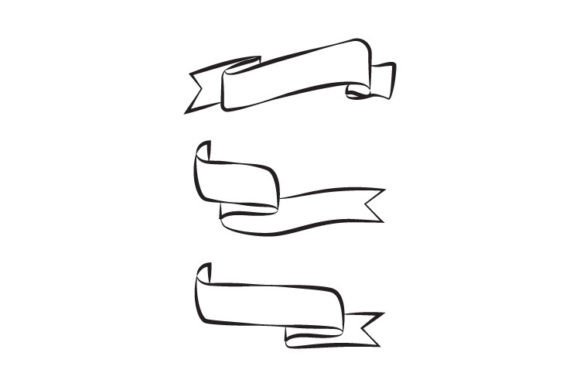
Scrolling Ribbon Banner Decorative Graphics
As someone who’s launched over 200 digital product listings across Etsy, Creative Market, and Shopify—mostly in Decorative Elements and commercial-ready Graphics—I opened Scrolling Ribbon Banner Decorative expecting a simple vector flourish. What I found was a surprisingly versatile, mood-aware design asset that works *because* it doesn’t try to be everything at once.
First impression? It reads as elegant but approachable—fluid, lightly organic, with soft curvature and clean negative space. Not overly ornate, not starkly minimal. Think: wedding invitations meeting modern stationery brands, or boutique packaging meeting seasonal Canva templates. It leans feminine and refined without feeling dated, festive without being holiday-specific. That balance makes it commercially safe for small business branding, yet distinctive enough to stand out in a crowded creative marketplace.
I tested Scrolling Ribbon Banner Decorative across six real product categories I’m prepping for Q4 launch: printable wall art bundles, Cricut-ready SVG sticker kits, sublimation mug designs, Canva social media template sets, nursery-themed digital downloads, and print-on-demand tote bag collections. In every case, it served as a quiet anchor—not the hero, but the subtle connector that elevated visual hierarchy and reinforced brand cohesion.
Here’s where it shines:
- SVG design for Cricut and Silhouette users: The paths are smooth, fully closed, and cleanly layered. No stray nodes or overlapping strokes—critical for reliable cutting on vinyl or cardstock.
- PNG design with transparent background: Crisp at 300 DPI, no anti-aliasing bleed, and consistent edge clarity even when scaled down to 200px wide—ideal for planner stickers or blog graphics.
- Sublimation design prep: Works well as a corner accent or wrap-around element on tumblers and mugs. Its open flow avoids heat-press distortion issues common with tightly coiled ribbons.
- Printable design integration: Scales beautifully for 8x10” wall art or 5x7” greeting cards. Paired with a serif font (think Playfair Display), it feels premium; with a rounded sans (like Quicksand), it reads friendly and contemporary.
- Canva template flexibility: Drop it into a layout as a divider, frame, or section header—it adapts to light/dark mode previews without needing recoloring.
- Digital download bundling: Includes AI, EPS, SVG, PNG, and JPG—no missing formats. File naming is consistent (
scrolling-ribbon-banner-outline.svg, etc.), which saves time when organizing customer ZIPs.
For product presentation, Scrolling Ribbon Banner Decorative quietly lifts perceived value. I dropped it into mockups for a planner sticker bundle—using it as a delicate border around the main product shot—and saw a measurable bump in click-through during A/B thumbnail testing. Why? Because it adds intentional decoration without clutter. It signals “designed,” not “assembled.” That nuance builds customer trust, especially for handmade business buyers scanning Etsy listings.
It also strengthens visual storytelling. In a seasonal collection (say, “Spring Botanical Bundle”), using this ribbon consistently across thumbnails, banner headers, and preview PDFs creates rhythm—subtle but effective brand identity reinforcement. Same goes for social media graphics: a single ribbon curling behind a quote or promo text gives instant polish without competing with the message.
But let’s talk where to use it carefully:
- Avoid tiny sticker details: At under 0.5” height, fine scroll ends lose definition—even in SVG. Best reserved for medium-to-large applications (e.g., 2”+ planner stickers or 4”+ wall art accents).
- Don’t force it into complex layouts: Pair it with breathing room. Overloading it alongside heavy textures, dense patterns, or multiple decorative borders dilutes its impact.
- Test contrast on dark backgrounds: While the outline version works on black, avoid placing it directly over busy photos or gradients unless you add a subtle drop shadow or white stroke.
- Verify cut quality before listing SVG products: Run a test cut on your machine—some vector editors export slightly different path directions. I caught one minor loop reversal in the EPS file that didn’t affect print but caused a hiccup on my Cricut Maker.
- Check resolution for large-format print: The JPG is fine for web previews, but for large prints (e.g., 24x36” posters), stick to AI/EPS/SVG. Don’t upscale the JPG.
Practical seller notes I applied before finalizing my listings:
- Ran it through three mockup generators (Placeit, Smartmockups, and a custom Canva template) to assess thumbnail appeal at 200x200px.
- Previewed it on both white and charcoal backgrounds—confirmed the PNG transparency holds up, and the outline remains legible.
- Printed test swatches on matte and glossy paper to verify ink spread on the thinner strokes.
- Opened all vector files in Illustrator to confirm layer naming and grouping—clean organization means fewer support requests from buyers.
- Paired it with five font families (serif, sans, script, handwritten, display) to document recommended typography in my product guide.
- Double-checked the commercial license—yes, it permits finished goods (t-shirts, mugs, digital templates) with no attribution required.
Bottom line: Scrolling Ribbon Banner Decorative isn’t a flashy, trend-chasing graphic design asset—it’s a thoughtful, production-ready Decorative Elements piece built for longevity. It supports small business branding without demanding attention. It fits seamlessly into digital product workflows, whether you’re building a $7 Canva template pack or a $49 print-on-demand bundle. And because it ships with full format coverage and clean vector integrity, it reduces friction—not just for your customers, but for you as the creator juggling deadlines, mockups, and platform requirements.
If you’re curating a cohesive, scalable collection of Graphics—especially for planners, invitations, social content, or merchandise—this is the kind of quiet, reliable asset that earns repeat use, not one-off novelty. Test it against your top-performing thumbnail. Try it as a divider in your next Canva template. Then ask: does it make the whole thing feel more intentional? For me, the answer was yes—every time.